
This was a double "aha!" experience for me when, after a talk on brand story, a participant in the Q&A session asked me: "Can you actually apply this to your personal brand?"
The answer is not only "Yes, absolutely!", but even much more than that: Story only works for brands and in marketing communication at all because story works for us humans as the most important method of explanation.
TOO LAZY TO READ ON? THEN LISTEN TO ME:
In the blogcast, I read this recent blog article to you. With emphasis, of course!
With stories we make connections, locate ourselves and find paths to meaning. Story is our sextant for determining our position in the sea of values.
With stories we explain life, the world, circumstances, situations, goals - simply everything - to ourselves and to each other.
Yes, most of what we know we have learned through stories - especially what we have learned about cultural, social and interpersonal issues and when it comes to sharing experiences and values. We take experiences - stories experienced or shared - as templates for new images, project them into the future, paint them out and put ourselves in them.
Story - the compass that points to ourselves.
With stories we ask questions and question ourselves, we put ourselves to the test, we put ourselves up for discussion and debate.
With stories we seek meaning, in stories we find meaning, with stories we give meaning - they show us our calling and where our meaning becomes possible.
This is where my lifelong enthusiasm for everything that story really does for us humans stems from, far beyond the functional and technical tool of storytelling. Stories are our evolutionarily programmed operating system, our general compass, with which we can orientate our souls in the vast, confusing land and which gives us orientation in the thicket of possibilities.
Alone - a compass that so many people lack: Why is that? Does it have to be like this?
Our big and small stories, the stations on our journey through our time on earth, intertwine arabesque-like to form the story of our lives. In constant ups and downs, a great arc of transformation spans from our first breath to our last. At the end of this transformation - or with luck perhaps sooner - we have hopefully arrived where we are meant to be: at our innermost truth, at our destiny, that is, at ourselves. We have found ourselves.
Story - Techniques of transformation.
Our life is a long string of pearls of transformation. Each story tells of a transformation, of a journey of a person who sets out from his familiar world to reach his bliss. At the end of a successful journey, not only is something different, but everything is better.
On the outside, this transformation is often about solving a problem, chasing something desirable or defeating an opponent. On the inside, however, it is always about learning, recognising, understanding and finally applying what has been understood. The true opponent is - in various disguises - usually a part of our old self that is no longer supposed to belong to our true self and must be defeated. In this way and only in this way do we continue to develop.
This journey through life's adventure never takes place in a comfortably equipped first-class compartment with the best service, but on foot, in shoes that are too small, on stony, steep paths, against wind and weather. Most of the time, we are also inadequately equipped and miserably prepared for it, because the departure for this journey is rarely planned and voluntary. We are nudged, pushed into it, at any rate pushed out of our comfort zone and only reluctantly start moving. We just know instinctively: the journey is arduous - change means pain. Every single stage promises plenty of suffering and deprivation, toil and plague.
But setting out - forced to set out - on the arduous path is and remains the only method by which we can finally reach our desired destination. Many people therefore refuse the call, avoid setting out and thus do not write their history.
Your story - the perfect wave.
Most of us at one time or another have been elegant surfboards in search of the perfect wave, but didn't have our compass to hand or ignored the direction it was pointing us, and now stand before the pile of our dashed dreams - as sad ironing boards. Ironing boards on which others spread out their fresh laundry, because one person's perfect wave sometimes looks like a tidal wave to another, or like a pond.
People without a story compass thus inevitably allow others to write a story for them in which they are not the heroes but supporting actors. They play a supporting role in their own lives.
You can recognise these people by their dawn in the morning, their blank looks on the underground and on holiday in the most beautiful places on earth; by their postings about the horror of Mondays and about all the horny drinks on Thursday, Friday, Saturday and Sunday.
Perhaps the massive increase in drug use worldwide is not just a sign of partying and good humour, but for the outright opposite?
Those who do not live their story instinctively feel a great emptiness inside them that urgently needs to be filled again and again. For this we have invented a few simple, highly effective excuses for civilisation, behind which we hide from the lead role on offer.
The three most densely populated hiding places, according to my observation, are:
1) We pretend to be totally busy with our work and other commitments, so that we luckily can't have time or energy for our own story.
2) We buy stuff to fill this inner emptiness.
3) We distract ourselves, nowadays preferably by scrolling through social media feeds, and we watch others act as supporting actors in their own lives.
We love to define ourselves by our comfortable exterior so that we don't have to face our vulnerable interior. Nevertheless, the inner emptiness remains and stares at us with different, ugly faces.
The face of ever-changing partners.
The face of dissatisfaction at work.
The face of the exhausted soul vulgo burn-out.
Emptiness speaks its own language with a limited vocabulary: actually, sometime, if, but, should, shouldn't, can't ...
Story - the path to Bliss.
If you don't know your story, you can't live it; if you don't live your story, you lack meaning. He who does not see his meaning feels irrelevant and meaningless - the worst thing that can happen to a human being. He wears the face of the exhausted soul with an empty look and gets by with a compact vocabulary that only consists of "should have".
It also works the other way round, as Viktor Frankl tells us: "He who has a why to live can bear almost any how."
It only works the other way round.
Those who know their story may not always know the specific destination, but they can see the light of their destiny sparkling and follow it. - "Follow your Bliss!", Joseph Campbell called out. Be ready to break free from your life plans and live the life that is waiting for you.
Find your story and follow it - your Bliss, your destiny, your mission, your bliss, your truth, your Holy Grail ...
Joseph Campbell, the US mythologist, explored the irrepressible power of stories in our culture and in our personal lives. He examined and identified the universal themes and archetypes present in mythic storytelling around the world, across all generations and cultures, and helped modern society understand them.
70 years ago, he developed the Hero's Journey, a model with which he describes the inner laws that underlie our stories to explain the world.
Joseph Campbell speaks of a monomyth, because in their structure all significant stories resemble each other - starting with the primeval myths of mankind, which form the basis of his work. On her journey, the heroine - i.e. the main character of the story - passes through 17 stations of development, from the departure from the familiar world to the liberated return home.
He became aware of these myths through Native American stories and pursued them further to the sagas of the Holy Grail and King Arthur. Today, his knowledge has long since landed in Hollywood. Star Wars by George Lucas, who greatly admired Joseph Campbell, was supposedly the first screenplay that was consciously written according to the model of the hero's journey. And if you look at the mythic structure of the film with an alert eye, you realise that King Arthur and Luke Skywalker are the same characters as Merlin and Obi-Wan Kenobi. The legend of Arthur is Star Wars in the Middle Ages and Excalibur is just another word for Lightsaber...
From this mythological power and spiritual archaism stems the magnetic fascination that stories exert on us, on each of us subconsciously, on us story insiders in many more dimensions that we are aware of.
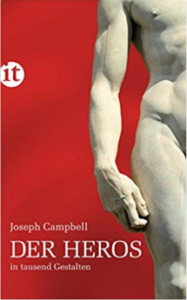
If you are interested in Joseph Campbell's scientific work, then you should read his work "The Hero in a Thousand Forms" from 1949, which still points the way ahead today, and take a closer look at the website of the Joseph Campbell Foundation website in more detail.
With everything I know about it and learn every day, my enthusiasm for it increases. Sharing this enthusiasm in an inspiring and helpful way is probably my Bliss. This is also the subject of my book on storytelling, which I have been writing for many months - unfortunately not with the necessary intensity. It won't be a technical book about storytelling methods, there are already enough of those, but it will deal with the roots, where we grew up with story, and how story makes us strong - as people, as companies & organisations, as a society ...
Know your story - follow your Bliss.
I have condensed Joseph Campbell's model of the hero's journey in my Hero Branding® method into a simplified, easy-to-understand and practically applicable version and will walk through the individual stages with you in the next episodes of my blog for all Story Insiders.
Whoever understands the hero's journey has a powerful tool at hand that works in many fields of application: of course in understanding and creating stories in literature, in film or on stage; for use in marketing communication, for example in pitches, speeches and presentations; or in the development of brand stories, for igniting enthusiasm to move people, i.e. in leadership; and above all in understanding the world, explaining one's own life or individual chapters of one's life. That too is leadership, because it is not by chance that it is called "leading one's life".
If you know your story, you will succeed. If not, others will lead you in their lives - as a supporting actor. Therefore: Follow your Bliss!
Because every person, but also every company - regardless of whether it is a global corporation or an SME - every organisation needs meaning, a mission, a purpose, bliss, i.e. at least one archaic value and the story it activates, around which everything revolves. This is how you win like-minded comrades-in-arms, this is how you become the heroine of your own story.
So to all those who say, "It doesn't apply to me or to my brand!", I would like to recommend the words that my grandmother, old Story Dudette, once whispered in Joseph Campbell's ear around the campfire: "No Story. No Glory."